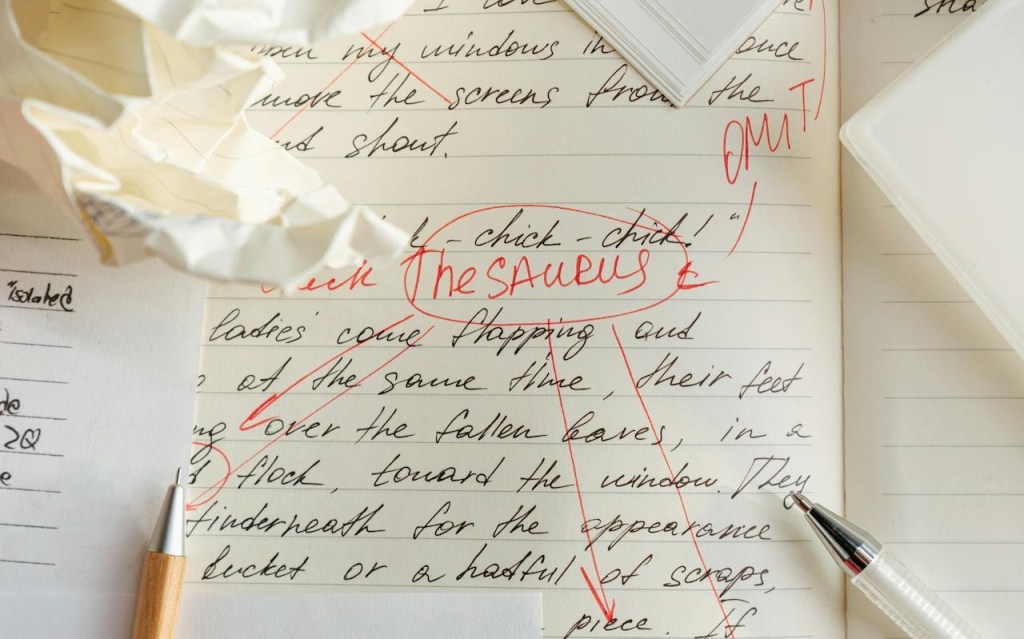
In editing, a small causal fix can percolate into cascading character and plot improvements. When I experienced this recently, it was like an epiphany: Sometimes editing is just pantsing by another name. And plotters should embrace it.
Make your editing pass with the pantser mindset even if the current read-through aims at line-edits (spelling, sound, dialog, …). But especially if you’re hunting for developmental-editing issues (plot-flow, theme, consistency, …), i.e. the cracks in the story. Patching any such flaw is, by definition, a late-bound artifact that planning alone didn’t catch, so the fix will, by necessity, be pants-oriented.
We’ll review plotter/pantser later but first let me introduce you to kintsugi.
What Writers Can Learn From Japanese Potters
No, that’s not a typo. But potter does rhyme with plotter.
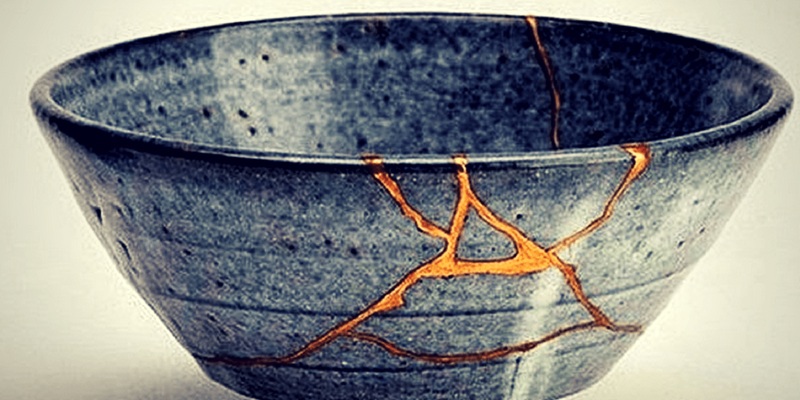
Kintsugi is the Japanese art (or more broadly the philosophy) of repairing the broken in ways that do not hide, but acknowledge, the flaw. Our imperfections, damage, and loss become a patch by which we are beautified, storied, and cherished. And a reminder of fragility and humility.
Artists fix the break with resin inflected with silver or gold, and so draw the eye to the hurt while imparting texture and honor to its recovery.
Applying this metaphor to editing, you should set about to fix each crack in the story in a rich, deserving way. Don’t just use spackle. The richness will encourage you to let richness propagate. Now, of course, you may not want your reader to see there was ever a horrific plot-hole in your story, but you, your authorial/editorial self, should delight in its kintsugi. That’s what I’m saying.
Alright, so what brought all that to mind? And what’s it to do with pants?
A Revision Example: Strengthening Plot and Character
In editing The Curse of the Unholy Grail, I came upon a crack in the plot. (Mild spoilers ahead, be warned.)
FBI Agent Nicole Lange, newly minted dhampir, finds her super-hero secret-identity discovered by bad-guys. They do a brutal daylight kidnapping from which Nikki makes a distinctly brutal escape. So much for the uneasy good-guys/bad-guys truce. Here’s the flaw: I was so focused on her lost anonymity that I glossed over the unprovoked act of war. The good-guys should fuss. The crack should be fixed.
I decided to have Nikki’s vampire-hunter allies do a tit-for-tat kidnapping of one of the undead prince’s favored ‘children’. They release her (a warning, not an escalation), but tattooed with latin verses that curtail her vampiric power a while.
Here’s where adding a little powdered gold to the lacquer makes it kintsugi: The vampire, Suvi, felt ‘marred’ by the holy verses, violated by the hunters, ashamed by her ambush, and abandoned by her kin. Before, she was an apex predator, but after she knew herself to be unsafe, insufficient, unimportant. The new glue-scene had imparted her character with vast emotional depth and a boat load of motivations.
Pantsing to Follow the Cracks
Where the vein of gold would go, I couldn’t yet have predicted. But I was so delighted by the result.
Originally, Suvi was going to become a complication for another vampire (potential ally of our heroine), yet Suvi’s only discernable motivation to meddle would have been … pretty much … psychosis. Now, however, once Suvi returns to the compound, she finds herself rejected by her father, the prince, and thus by the entire court. How easy it now became for Suvi to pin her sense of failure on the vampire who first found her stripped and marred. How inescapably and irreversibly it became for Suvi to want to punish and dismantle the embodiment of her shame. First problem tidied.
Suvi’s fall-from-grace degrades her nepotistic station as well, clearing the way for another character to seduce her way in. And that change better allows this ‘other’ to play court-intrigue games that formerly called for some suspension-of-disbelief. Second problem tidied.
Suvi’s desperation to regain her honor also makes her recklessly press an attack after the vampire elders had already accepted the prior outcome. The rogue action helps good-guys penetrate the formerly impenetrable. Third problem tidied.
Wow! I was just grinning like a kid at Christmas. Patching one flaw can do all that!?! It felt like I was channeling ancient pants-masters of the literary pantheon.
Now, it also reminded me of a Vonnegut-ism “Every character should want something, even if it is only a glass of water.” Every character, major or minor. Suvi becoming more than two-dimensional not only made her more real, but made other areas of the story richer and more natural as well. Thanks to my pantsing editoral pass.
(Breakfast of Champions fourth-wall-breaking meta-fictional lesson aside, I’ve also resolved to do better by my minor characters.)
Dang it, N. L. Bryar, are you a plotter or a pantser? Fess up! I hear you say.
Plotter vs. Pantser: Which to Be, When
Here’s the plotters and pantsers polarity: Plotters like to outline (most of) the flow of scenes beforehand, while pantsers ‘fly by the seat of their pants’, letting the story come to them as they go.
I’d say I’m a somewhat-plotter. Usually, when I think of a story, I first think of a few vital scenes, then I have to figure out how to stitch them together. Say I knew there had to be a betrayal scene and I envisioned it in full Technicolor glory and Dolby Surround Sound, well, I then need to have an idea what lead to it, made it inevitable, made you give a hoot when it arrives, and then what it will complicate after it happens (which might subtly tweak details of the betrayal). All these development-mode thoughts occur out-of-order in the story-timeline, so I need to record these gists someplace. That place may lack Roman numerals, but it’s still an outline. Voilà. Plotter.
Oh, and scenes need to pull their own weight. If it doesn’t motivate another scene, reveal some B-Story, introduce or resolve some conflict, then I ought to cut it (or amend it to matter). Yes, a pantser would reach the same conclusion during editing, but there’s less despair and moping if caught at the index-card stage than after a fully-realized and polished twenty pages. (See Writing a Novel? Pick Scrivener over Word for my corkboard tips.) Not to say I never go the despair and mope route (see Cut Scenes).
Plotters, you’re going to be wearing pants when you arrive at the planned-scene that you realize is crap. By the seat of those pants will you save the day. It might mean throwing-out lots of subsequent scene index-cards. Yeah, … that happens.
No, the biggest reason, I bet, people choose pantsing is that the scene unfolds in its richest way only when you’re in the midst of it. It’s too sterile at the 50,000 foot overview. God forbid your brain enters some summary-mode where you can’t get the scene even unfold if you feel hemmed-in by the index-cards on the other side. It’s more enjoyable and authentic, for such people, to write the movie the Muses are projecting in their head. So, in that sense, I’m a somewhat-pantser.
Ideas will come to you only when they come to you. At any point, then, inspiration will force revisiting the causal chain, backward to what you’ve already written, and forward in time to where you haven’t.
Half the story, meanwhile, only comes to you as you give life to the characters, watch them make choices, see their personalities emerge, and notice what particles fly out after their high-energy collisions with plot-elements and each other. As my dhampir protagonist must reconcile her dual natures, so to do you.
Don’t choose a side. Play to your strengths, … but you’re going to be both people before the book’s done. But edit in a pants-forward way.
Editing is discovery, not just clean-up. Do the pants-based kintsugi thing and you’ll far better enjoy your editing.
Thanks for reading.

Leave a comment