
Imagine the conflict when the ultimate predator is also its own most vulnerable prey. Picture the turmoil when the very source of the hero’s power becomes the catalyst of the hero’s corruption. That’s the dhampir, a being fusing human and vampire natures, under a heat and pressure that deform both. If the yin and yang of a normal life twirls like a merry-go-round, the dhampir’s spins like a saw blade. Sink your teeth into the dhampir mythos … before they sink theirs into you.
We’ll start by showing why dhampirs are compelling protagonists and end with a suggested reading-list. Ready? Let’s go.
Dhampir As Symbols
Call them a liminal figure, a hybrid archetype, a metaphor for duality — whatever expression you prefer, the dhampir states an inescapable truth: Inside all of us, no matter how cultured and civilized, lurks a savage monster.
What are we going to find within the dhampir? The same lessons on identity and divided-self we encounter in The Curious Case of Dr. Jekyll and Mr. Hyde or The Picture of Dorian Gray or Herman Hesse’s Demian (in particular that light/dark is more subtle than good/evil or order/chaos).
In my own Urban Fantasy (upcoming) book, Special Agent Nicole Lange, like Dr. Jekyll, explicitly calls forth the monster within. And the more she indulges her Hyde, the more and the deeper she desires to do it again. To quote ‘The Cure‘ (and, given opportunity, one always should) “The further I get from the things that I care about, the less I care about how much further away I get.”
The dhampir represents a hybridity, a bridging of opposites, a potential to accept and unify and achieve greatness. In contrast to the Doppelgänger motif, two halves, external, destined for widening, irreconcilable division and a tragic end. Not so the dhampir, wherein there’s hope.
Humanity attaining forbidden powers appears in many of our oldest stories, stretching back to The Expulsion from Eden where knowledge curses what it blesses. But the dhampir carries yet more freight: the struggle to transcend assigned labels; the moral ambiguity of using something tainted for the sake of good; the constant temptation, rationalization, and cognitive-dissonance involved in defining who we are; the blurred line between heroism and monstrosity; fall and redemption; the fragility of free-will.
The point is this: The dhampir’s battles are ours, just framed by a magnifying-glass. What author can resist that?
The Rise of the Dhampir
In the Balkan traditions, where the idea first emerged, a dhampir was said to be the child of a male vampire and a human woman. The word originally comes from the South Slavic vampir, morphed by Albanian influence into dhampir, a term that organically came to denote a vampire-related person. Across the region the name changes but the idea persists—dhampyre, dhamphir (per vampirefacts.net), vampirović (Serbian), lampijerović (Bosnian), vampuiera (Romani), and others—each a linguistic fingerprint on the same half-shadowed figure.
Folklore does not paint all dhampirs with the same brush. But, generally, their dark lineage colors yet does not consume the dhampir. They’re not fated to be tyrants nor even to be driven by insatiable hunger for the living. Though they might wield supernatural strength or even practice unnatural magics, they may escape succumbing to monstrosity (per monstropedia).
That said, modern storytellers can’t resist a fall-from-grace tale. Take Gilles de Rais, Marshall of France, fighting companion of Joan of Arc, yet de Rais spiraled into depravity, torture, and murder. Of children. In a retelling of the tragedy, we find a dhampir who lost balance, then control, then humanity. Or consider Erzsébet Bathóry, the countess who bathed in young girls’ blood. She has been portrayed as a dhampir tipped too far into her darkness.
As fictional characters, I feel dhampirs have only recently come to the fore. Across many tellings, the dhampir is a character of multiplicities — hunter and haunted, boundary and bridge. Certain plot-roles, however, appear frequently. The first being hero/slayer.
In the Role of Slayer / Protector
In eastern European legends, the dhampir typically shouldered the role of vampire-hunter. (Some other names for dhampir such as vampirdzhiya or vampirar end in a suffix meaning “hunters of”.)
To see how these ideas play out in modern media, let’s look at some contemporary dhampir pieces.
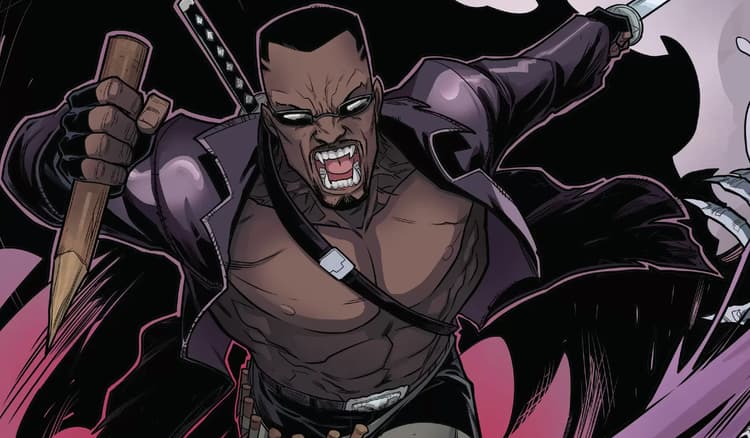
Blade was later more fully empowered by the scientifically-enhanced vampire Morbius’ bite, granting him inhuman strength, keen senses, and other vampiric boons … and banes, like crippling blood-thirst (which he manages by a special serum).
Other examples include Magiere from The Nobel Dead series and Joe Pitt from Joe Pitt Casebooks. I suppose a name like Vampire Hunter D kind’a gives away his vocation, too. Rose Hathaway from Vampire Academy is a protector (of vampire Lissa).
The Tortured Soul Role
There’s an enormous emotional burden for the dhampir. With amplified skill comes amplified ambition, with elite power comes elite hubris. The dhampir is uniquely positioned to achieve miracles or achieve horrors. Balancing their dual-nature is an exhausting, confusing, razor-thin path to walk.
Vampire Hunter D is a tortured soul, an isolated wanderer, rejected by both human and vampire societies. Nicholas Gaunt from Dhampire: Stillborn is a tortured-soul … who succumbs.
Nicole Lange finds herself thrust into a struggle of world-ending proportions, a struggle dividing vampire-kind and forcing alliances she never thought she would form. Our FBI-agent-turned-dhampir heroine finds herself a “morally gray protagonist”, a tortured soul not only by the nature of her duality, but the nature of her mission.
Forgive my slight departure here, he’s not a dhampir, but we have to talk about Angel from the Buffy-verse. He is a twice cursed being: first losing his soul to vampirism, then cursed by gypsies to regain it. Knife-edged duality.
Protecting the innocent from the incursion of evil gives Angel’s life meaning. Yes, he’s atoning for his wicked deeds, but really meaning is more transformative than guilt.

The Weapon of Vengeance

In the BloodRayne franchise, Rayne, hunts the vampire Kagan, who ‘fathered’ her, murdered her entire family, and inducted her into his army of vampires.
Rayne faces Kagan multiple times, stopping him, for instance, from raising the Zeta Gamma demon. Fighting to stop ‘The Shroud’ devised to let vampires walk in daylight, etc.
“You saw the blades. What did you think was going to happen?”
–Rayne
What started as a vendetta for Rayne morphed into protecting the world from Kagan’s evil machinations more generally. That’s a more satisfying heroic arc, vengeance to protection. Through her association with the Brimstone Society, she now protects humanity from all manner of super-naturals.
Back to The Curse of the Unholy Grail, Nicole Lange latches onto dhampirism all too quickly on learning the man who killed her parents seeks supernatural world-domination. Then come the questions of costs, scope, method, and constraints. The Apocalypse demands more of her than just revenge. Luckily, she has the Cambionai-Statioteis and the shadow organization within the FBI to aid her.
Other roles include Mediator (demigod-like Kate in Kate Daniels series negotiating between vamp factions, werewolf clans, witch covens, …) and Chosen-One.
The Dhampir Reading-List
The dhampir archetype is multi-faceted and deep, yet accessible and familiar. With many standard elements, you’ll be grounded in context for the plot, obstacle, or conflict by even the briefest nod to a wide list of Dhampir tropes in media. Most genre-fiction here is going to be fast-paced, action thriller fare (with a dose of romantasy, though I don’t focus on it).
Let’s explore some titles below. Disclaimer: There are a few series to choose from and many are comprised of multiple books, so I’ll confess I haven’t yet read everything below. (Don’t search Amazon for “dhampir”; you’ll feel totally overwhelmed). Here’s my 2025-end want-to-read list.
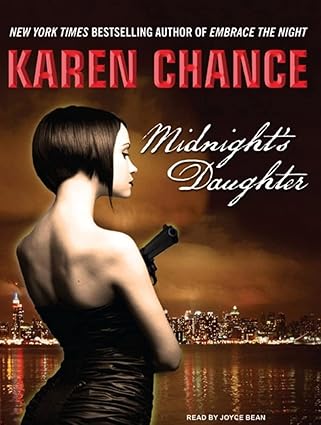
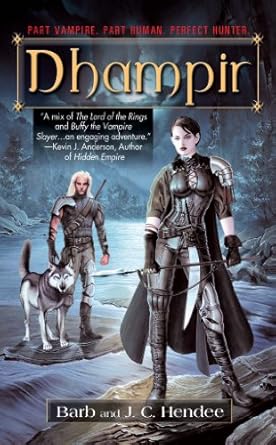



- Dorina Basarab Series — Karen Chance
I’ve read Midnight’s Daughter and enjoyed it. Dorina has stubborn, vulnerable, humorous traits I think readers will connect with. The books move. They’ve action, rapid-fire progression, and political intrique. There’s humor and chemistry and whoop-ass. Give ’em a try. - Noble Dead Series — Barb Hendee and J.C. Hendee (nobledead.org)
The danger and mystery, the hidden magic, the fantasy setting, readers love this “dark but cozy” series. Magiere and Leesil are morally-burdened protagonists, akin to Nikki, running toward yet away from their past. There’s a just-one-more-chapter insistence to their momentum and revelation. This series is top of my list to read for the holidays. - Vampire Academy Series — Richelle Mead
Oh, you’ve heard of this series, I’m sure. YA dark academy gold. Rose Hathaway is a dhampir, a protector for the Moroi vampires, and in particular for Lissa, a princess with a chosen-one political destiny. No time for the books? Stream the TV series. - Dhampire: Stillborn — Nancy Collins
This could be considered the progenitor of modern dhampir tales. Nicholas Gaunt has always felt alienated until the revelation that he’s a dhampir opens a door he never knocked upon to enter. The more Nicholas learns, the more haunted he becomes, descending ever deeper into the abyss. The original anti-hero dhampir.
And Nancy loves vampires, so … books aplenty from her. - Hellcat Series — Sharon Hannaford
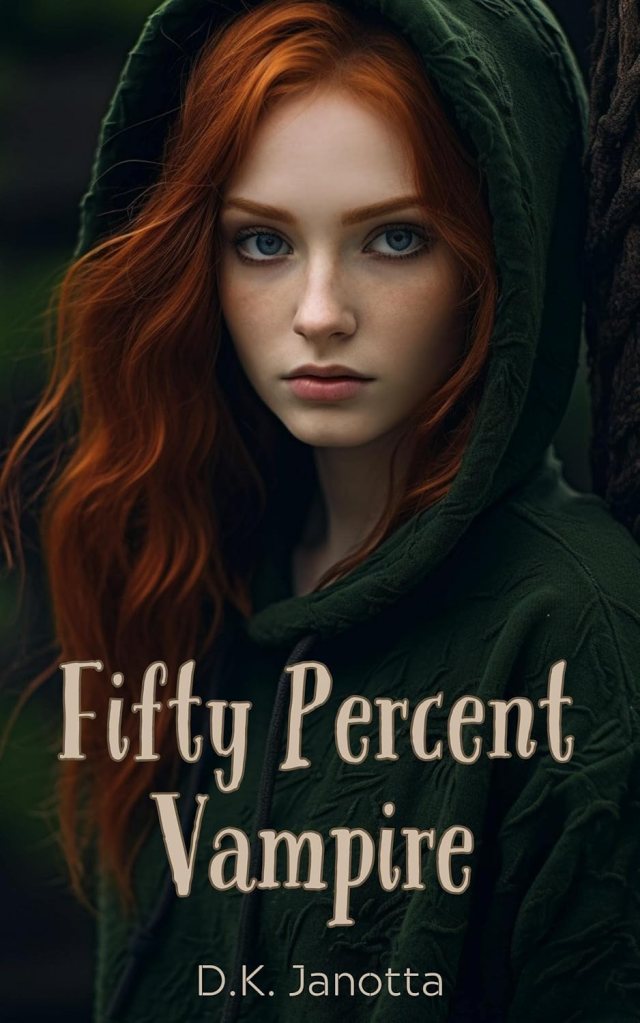
A dhampir protector with the Societas Malus Venatori and a mediator with the werewolf clans, Gabi is a fearsome FMC. “Five parts action, one part romance” (yea, proportions!). People feel it’s fast-paced, relentless, and a good telling of slayer/protector against demons and vampires, also having mediator diplomacy. Perhaps not a literary-style work, but a hidden-gem. - Fifty-Percent Vampire series — D.K. Janotta
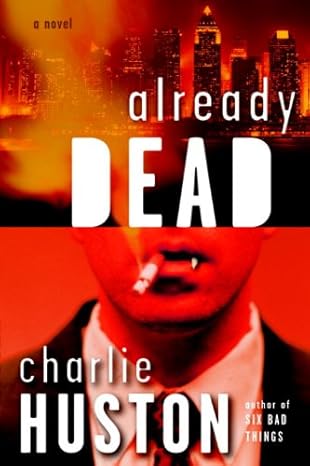
D.K. is a bit off-the-radar, but the premise of her series puts in on the list. The second book in the series appears to be where the author hits her stride (well received on Goodreads). - Joe Pitt Casebooks — Charlie Huston
Ok, he’s not a dhampir, but he is a liminal not-quite-them outsider character, riven with moral ambiguity and pulp-noir presentation. Strong, flawed, complex identity/duality themes. You’ll see dhampir-esque struggles in this vampire, so I’ll add this series to the list. Dark and violent, I’m told, FYI.
Top 3 entry-points for new dhampir-readers: Karen Chance, J.C. Hendree, Richelle Mead.
There are multiple other half-human/hybrid stories out there, not dhampiric per se, but most sharing some common themes with the dhampir archetype. Cutting, bold lines and asking stark questions. Fodder for another blog-post, I think.
Wrap
Whether you’re craving monster-hunters, morally gray wanderers, or tortured souls battling their own darkness, dhampirs deliver some of fantasy’s sharpest edges. Add books with dhampir characters to your “want to read” list — you won’t regret the bite.
In the comments, tell us what light/dark duality stories have caught your heart. And tell me what I should be sure not to miss in the genre. And, of course, share your opinions on the short-list referenced above.
If you’re an urban fantasy author writing dhampirs, half-vampires, or hybrid protagonists, feel free to reach out — I enjoy highlighting works that explore these themes.
As always, thank you for reading the post.

Leave a comment